

A Place Through Time:
The Mansion House is a Living Building
The Mansion House has been continually lived in since the first one was built in 1848. But it is also living in the sense that throughout its 170+ year history it is constantly evolving, being enlarged, adapted, improved, repaired, reinvented, and preserved according to the size, needs, and ideologies of the occupants, architectural styles, and American culture. As such, the Mansion House is a living building that has transformed from a communal home for the Oneida Perfectionists, an unofficial company headquarters and residence for the Oneida Ltd. Silverware Company, to a National Historic Landmark and Museum that preserves and tells the story of the Oneida Community and its legacy for generations to come. This whole history can be seen through the evolution of the Mansion House itself.
The evolution was something the Perfectionists openly celebrated. In their community periodical, The Circular, they wrote:
“Our eye is rather pleased, and our interest piqued by noticing the evidences of time, and the successive stages of progress that have passed over the work."
— Circular, February 22, 1869
First Mansion House
When John Humphrey Noyes and his band of followers arrived in Oneida in 1848, they came together to build the first wooden Mansion House on this site in less than a year.
This home was designed by the Community’s in-house architect, Erastus Hamilton and done in a vernacular style with decorative embellishments like the crenellated cupola and trellis piazza.
In only a few short years, the Community’s population boomed, making a new, grander home necessary.


1862 House
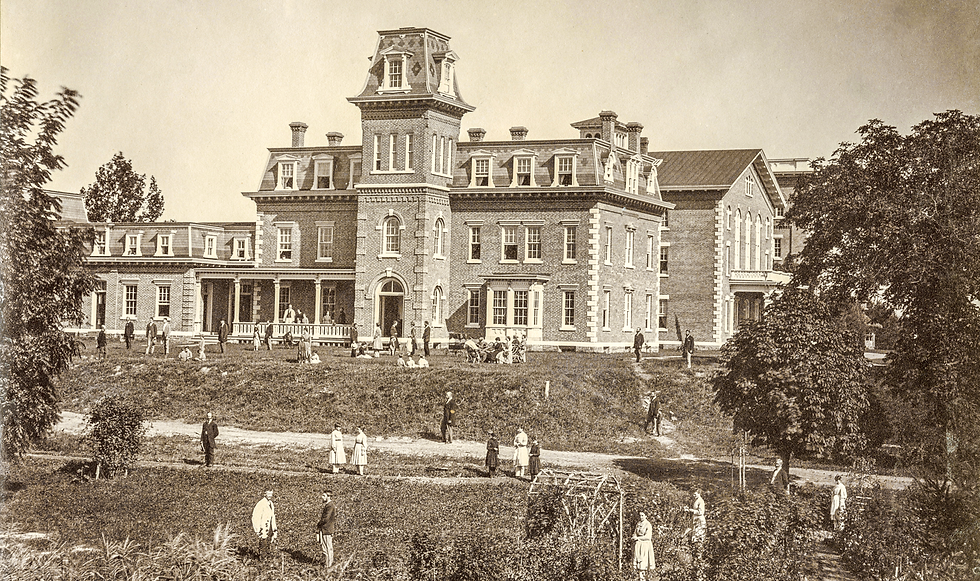
By 1862, due to an influx of people from the the Community built a larger structure that we know today as the Mansion House.
Throughout the 1850s, the Community came together to communally design their new brick home with the help of their architect, Erastus Hamilton. Drawing inspiration from leading American architects like Alexander Jackson Downing they designed what is now known as “The 1862 House” in “Italianate Villa” style that was very popular at the time. Not only was this home stylish with its wide roof, cupola, and tower, but it contained state of the art heating and ventilation systems.
Today it houses much of the museum space at OCMH.
The Tontine
The 1862 House was the main dwelling place for the Oneida Community. However, they built what is known as the “Tontine” in 1863 to house the Community’s laundry facilities, kitchens, dining rooms, and workshops for printing, silk thread dying, and other home industries.
Today, the Tontine still contains a kitchen and dining room and houses the breakfast bar for our Inn guests.

The South Wing
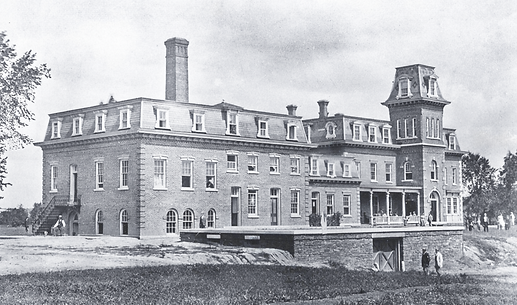
The introduction of the planned birthing program, Stirpiculture, in the late 1860s led to a baby boom in the Oneida Community, and they needed more space to accommodate all the new arrivals. Therefore, they added a new, massive addition to the 1862 House.
Known today as the “South Wing” or the "Children’s Wing," it was again designed by Hamilton but in the newest architectural style: The Second French Empire. It was defined by its two-part mansard roof that was not only fashionable, but also allowed for more space to the Community. Children were communally raised and schooled in the various rooms of this wing.
Today, the South Wing houses museum spaces and apartments for the Mansion House’s residents.
The New House
The last branch Community at Wallingford, Connecticut, closed in the late 1870s, and the residents returned to Oneida. Therefore the Mansion House needed to be enlarged again to welcome the new arrivals.
Unlike the other structures, this wing was designed by an outsider, Lewis Leeds. In the ten years since the last addition, architectural tastes had once again changed in America. Aiming to stay fashionable, what became known as the “New House” was designed in the neo-gothic style typified by its multi-colored bricks, spires, and pointed arch windows. The New House also contained very high ceilings and a state-of-the-art ventilation systems that was thought to advantageous for the health of the occupants.
Today, our overnight guestrooms occupy the first and second floors of the New House.


The Lounge
After the Oneida Community amicably transitioned to a joint stock corporation in 1881, the Mansion House evolved into a company headquarters and apartment building for former Community members, descendants, employees, and guests. In need of a recreation space, Oneida Ltd. hired a child born in the Community, Theodore Skinner, to design what is known as “The Lounge” in 1914.
Completed in the “Colonial Revival style” with its white columns and Palladian windows, it is used much like it was in the early 20th century as a gathering and event space for museum events, company meetings, weddings, and more.
Preserving a National Historic Landmark
Today, the Oneida Community Mansion House is still evolving and changing, but takes the form of historic preservation. OCMH staff, preservation architects, and specialized contractors are constantly at work ensuring that this structure stands for another 170 years as a testament to three centuries of people who strove to bring a piece of utopia into existence. Follow along on our Historic Preservation page as we repair roofs, rehabilitate brickwork, and rehabilitate porches, windows, doors, and everything in between!
Please help support this important work, consider making a donation to preserve the Oneida Community Mansion House today!.
